

What the New Federal Grant Rule Could Mean for Tribal Nations and Tribal Nonprofits
On May 29, 2026, the Office of Management and Budget (OMB), together with more than 40 federal agencies, published a sweeping proposal to rewrite the federal government’s Uniform Guidance (2 CFR Part 200)—the rules that govern nearly every federal grant awarded in the United States. At first glance, this appears to be a technical update to federal grant regulations. In reality, it represents one of the most significant changes to federal grant administration in more than a decade. For Tribal Nations and Indigenous nonprofit organizations, these proposed changes deserve immediate attention. The public comment period closes July 13, 2026, and OMB has indicated it intends to make the final rule effective October 1, 2026.
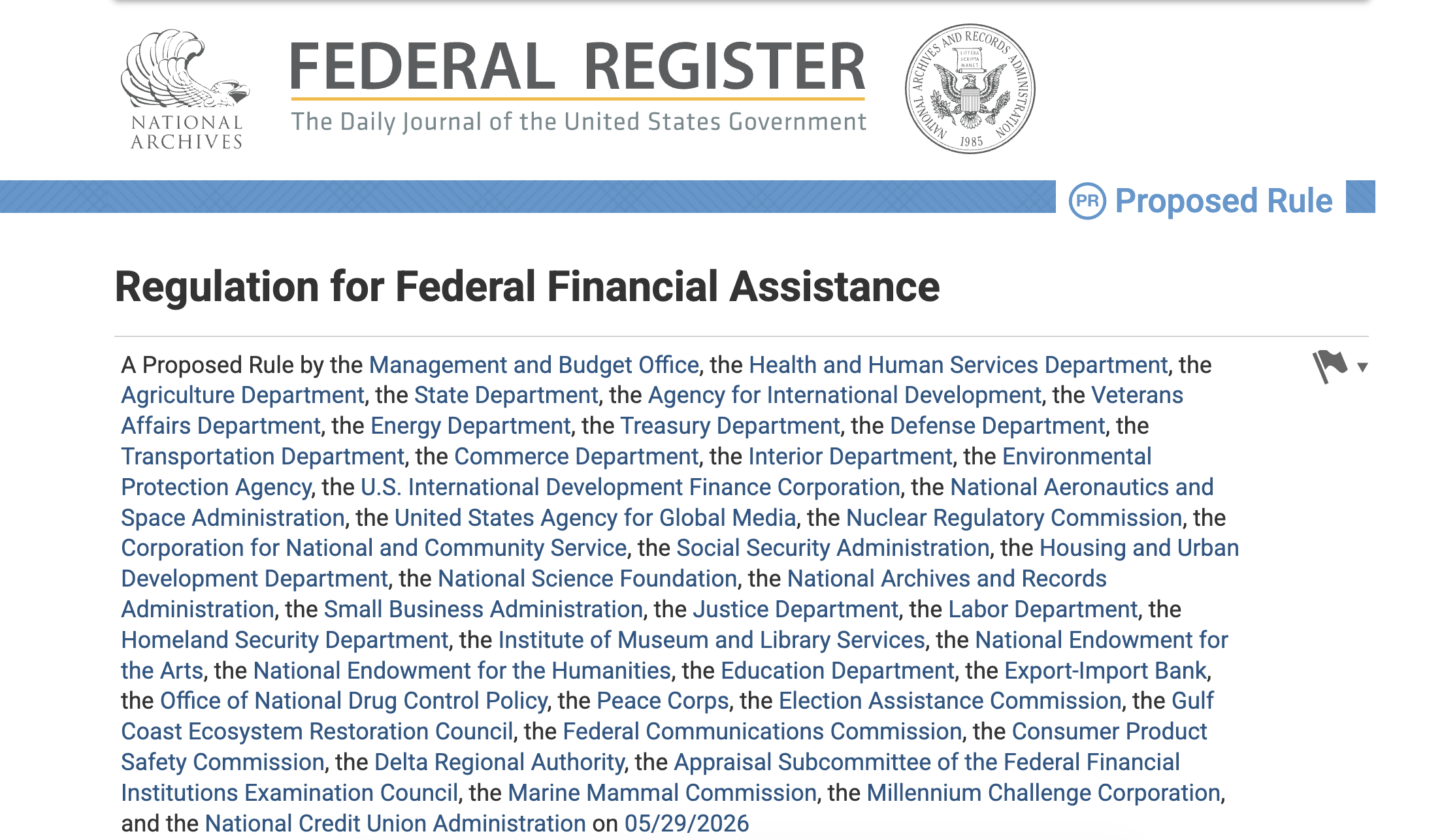
Why does this matter? Well, nearly every federally funded tribal program operates under 2 CFR Part 200. This includes grants supporting tribal governments, housing, environmental protection, water quality, climate resilience, public safety, language revitalization, broadband, transportation, education, cultural preservation, economic development, and tribal nonprofit organizations. If these rules change, virtually every federally funded Tribal program could be affected. I am going to lay it out for you in bullet format.
1. The Federal Government Would Have Greater Authority to Cancel Grants
One of the biggest proposed changes expands agencies’ authority to suspend or terminate grants. Under the proposal, agencies could terminate an award if they determine it no longer aligns with agency priorities, federal interests, or program goals. While agencies already possess certain termination authorities, this proposal would broaden and clarify those powers. Why should tribes be concerned? Many Tribal projects span multiple years, such as environmental restoration, broadband deployment, housing construction, cultural preservation, climate resilience, and land management. If priorities shift between administrations, projects that have already hired staff, entered contracts, or begun construction could suddenly lose funding. That uncertainty makes long-term planning much more difficult.
2. More Administrative Requirements
The proposal introduces additional expectations involving, internal financial controls, documentation, payment requests, reimbursement, monitoring, auditing, financial reporting Although intended to improve oversight, these requirements could disproportionately burden smaller Tribal governments and nonprofit organizations with limited staff. Many Tribes already struggle to recruit grant managers, accountants, compliance officers, and procurement specialists. Every additional reporting requirement takes staff away from actually serving Tribal citizens.
3. Fixed-Amount Grants Would Disappear
Perhaps one of the least discussed—but most significant—changes is the elimination of fixed-amount awards. Many Tribes rely on these awards because they reduce paperwork, simplify grant administration, and improve cash flow. Under the proposal, most grants would instead operate on a reimbursement model. That means Tribes may need to spend money first, document every expense, then wait for reimbursement. For smaller Tribal governments or Indigenous nonprofits with limited reserves, this could create significant cash-flow problems.
4. Native Programs Could Again Be Misclassified as DEI Programs
Perhaps the greatest concern expressed by Tribal finance experts is the proposal’s treatment of diversity-related programs. Several experts warned that federal agencies have historically confused, native identity (a political status), with race. This distinction matters. Indian Tribes are sovereign governments, not racial groups. Programs serving Tribal Nations are based upon treaties, statutes, the federal trust responsibility, and government-to-government relationships. Yet Tribal organizations have already experienced grants being delayed or terminated after agencies mistakenly categorized Tribal programs as DEI initiatives. Several Tribal commenters—including the Southern Ute Indian Tribe—asked OMB to explicitly clarify that Tribal programs are not DEI programs. Without that clarification, similar mistakes could continue.
5. Trust and Treaty Obligations Need Stronger Protection
The proposal does recognize Tribal governments in several places. It specifically acknowledges that tribal laws governing federally funded equipment, the Indian Self-Determination and Education Assistance Act (ISDEAA), and notes that statutory conflicts involving Tribes defer to ISDEAA. The proposal also states that OMB intends to conduct formal Tribal consultation before issuing a final rule pursuant to Executive Order 13175. However, no consultation schedule has been announced. Many Tribal leaders believe consultation should occur before major policy proposals are released—not afterward.
6. Tribal Consultation Has Not Yet Occurred
Executive Order 13175 requires meaningful consultation with Tribal governments whenever federal actions have Tribal implications. OMB acknowledges in the proposal that formal Tribal consultation has not yet occurred and states it will happen before the rule is finalized. For many Tribal leaders, this raises an important question. How can meaningful consultation occur after a 108-page proposed rule has already been drafted?
7. Indigenous Nonprofits May Face New Challenges
The proposal does not only affect federally recognized Tribal governments. It may also affect Indigenous-led nonprofits, tribal colleges, Native-serving organizations Tribal housing authorities, and consortium organizations. Organizations that depend on competitive federal grants may face more documentation requirements, greater compliance expectations, additional audits, more extensive application requirements, and an increased risk of grant termination. Many smaller organizations simply may not have the administrative capacity required.
8. Environmental Justice Organizations Could Feel the Effects
Many Indigenous environmental organizations—including those working on water protection, climate resilience, traditional ecological knowledge, environmental justice, land restoration, cultural resource protection, renewable energy, and Tribal conservation—depend heavily upon federal grant funding. Projects involving environmental justice, climate adaptation, Indigenous ecological knowledge, and community resilience could receive additional scrutiny depending upon how agencies interpret the revised guidance. This creates uncertainty for organizations already working under limited budgets.
What Tribal Governments Can Do Now
While the proposal has not yet been finalized, Tribal governments and Native organizations can begin preparing now. Some practical steps include reviewing active federal grants for potential vulnerabilities. Ensure grant narratives clearly reference treaty rights, statutory authority, and the federal trust responsibility. Avoid language that could unintentionally frame Tribal governmental programs as diversity initiatives rather than governmental obligations. Strengthen internal financial controls and documentation systems. Submit comments before the July 13 deadline. Participate in Tribal consultation once OMB announces it.
Final Thoughts
The proposed revisions to 2 CFR Part 200 are far more than an administrative update. They represent a fundamental shift in how federal grants may be awarded, monitored, reimbursed, and terminated. For Tribal Nations, the stakes are especially high because federal funding supports essential governmental functions—from housing and healthcare to environmental stewardship and cultural preservation.
The proposal contains provisions recognizing Tribal sovereignty and the Indian Self-Determination and Education Assistance Act, but many Tribal leaders remain concerned that it does not go far enough to protect the federal trust responsibility or prevent Native programs from being misclassified under broader federal policy changes.
As Indian Country reviews these proposed rules, one principle remains clear: Tribal Nations are sovereign governments with a unique political relationship to the United States. Any revision to federal grant policy must honor treaty obligations, the federal trust responsibility, and meaningful government-to-government consultation—not merely treat Tribes as another category of grant recipient. I am asking you to make comments before the period closes on July 13, 2026. You can make comments here, view alternative ways to comment, or comment via Regulations.gov at https://www.regulations.gov/commenton/OMB-2026-0034-0001.